
Driven by the Government, the DRC is accelerating its economic diversification and industrialisation strategy
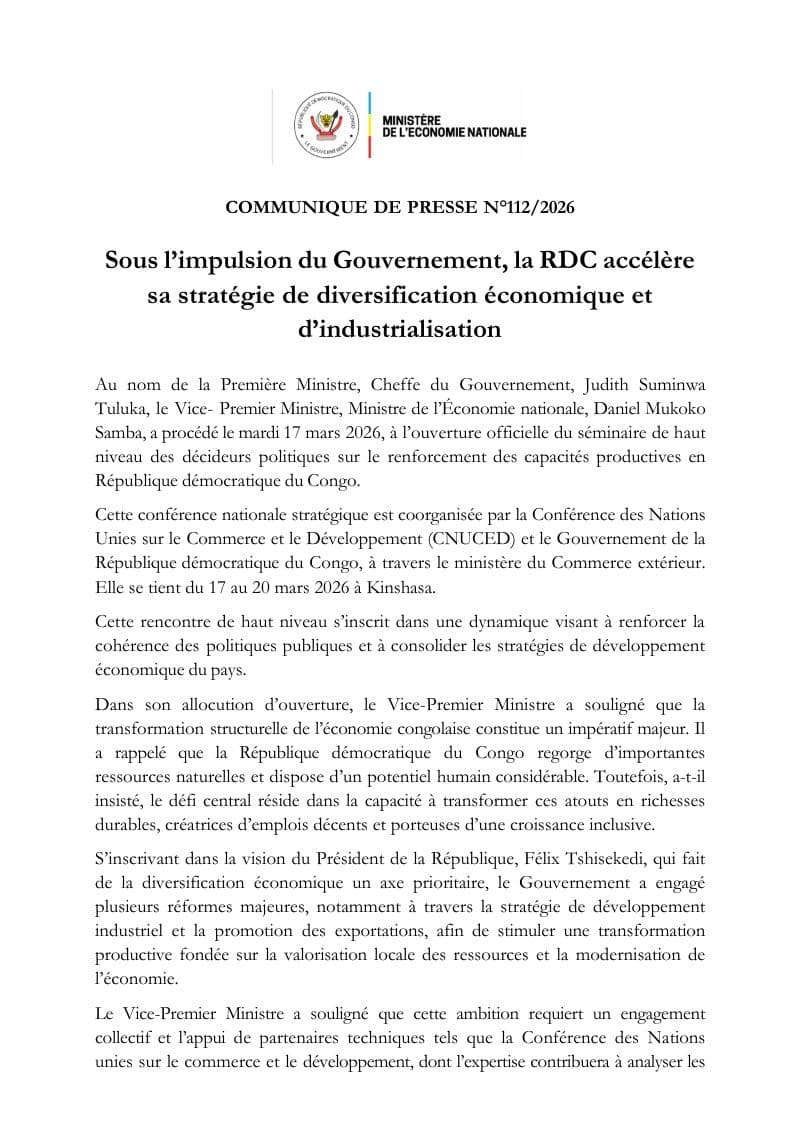
PRESS RELEASE No. 112/2026
Driven by the Government, the DRC is accelerating
its economic diversification and industrialisation strategy
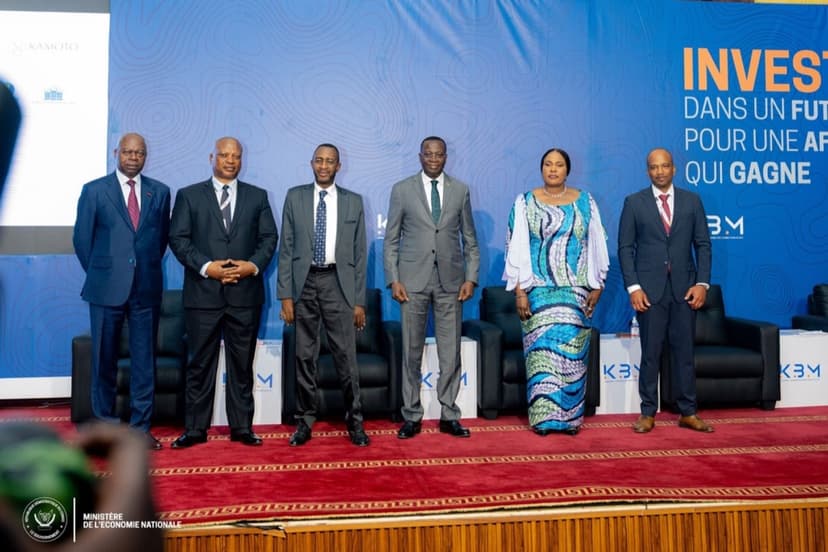
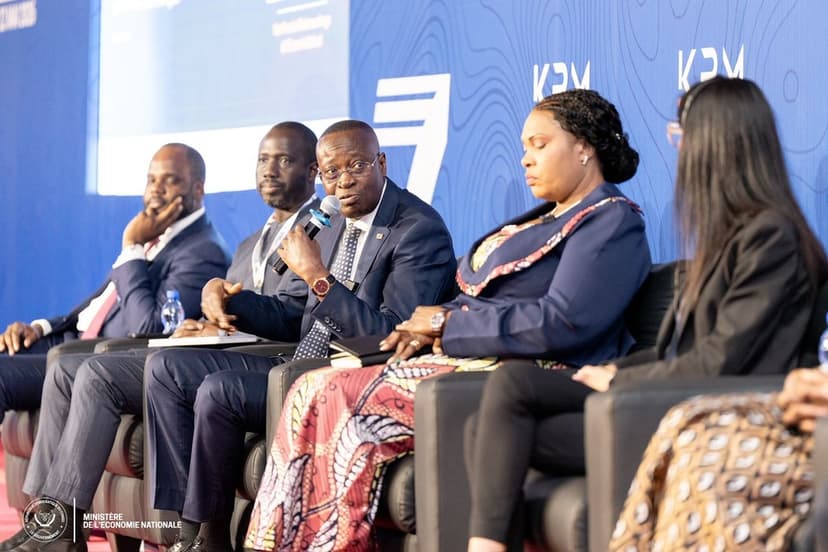
On behalf of the Prime Minister, Head of Government, Judith Suminwa Tuluka, the Deputy Prime Minister and Minister of National Economy, Daniel Mukoko Samba, on Tuesday 17 March 2026 officially opened the high-level seminar for policymakers on strengthening productive capacities in the Democratic Republic of the Congo. This strategic national conference is jointly organised by the United Nations Conference on Trade and Development (UNCTAD) and the Government of the Democratic Republic of the Congo, through the Ministry of Foreign Trade. It is being held in Kinshasa from 17 to 20 March 2026. This high-level meeting is part of a drive to strengthen the coherence of public policies and consolidate the country’s economic development strategies. In his opening address, the Deputy Prime Minister stressed that the structural transformation of the Congolese economy is a major imperative. He recalled that the Democratic Republic of the Congo is endowed with significant natural resources and has considerable human potential. However, he insisted, the central challenge lies in the ability to transform these assets into sustainable wealth that creates decent jobs and drives inclusive growth. In line with the vision of the President of the Republic, Félix Tshisekedi, who has made economic diversification a priority, the Government has undertaken several major reforms, notably through the industrial development strategy and export promotion, in order to stimulate a productive transformation based on adding value to resources locally and the modernisation of the economy. The Deputy Prime Minister emphasised that this ambition requires collective commitment and the support of technical partners such as the United Nations Conference on Trade and Development, whose expertise will help analyse the
weaknesses in productive capacities in key sectors such as agriculture, industry, energy and trade. This approach will make it possible to identify the structural constraints to industrialisation and will lead to the development of an inclusive “country programme”, aligned with national priorities, with a view to structuring, on a lasting basis, the value chains, strategic sectors and infrastructure essential to the economic development of the DRC. Addressing the institutional challenges in the DRC, he referred in particular to issues relating to natural resource governance, especially the management of mining rents, the implementation of revenue-sharing mechanisms for local communities, and the use of mining royalties. In this regard, he stressed the need to transform mining rents into sustainable competitiveness by investing as a priority in transport infrastructure, energy, human capital and institutional strengthening. In conclusion, the Deputy Prime Minister called for a structural transformation of the State, based on the establishment of centres of excellence responsible for the strategic management of the national economy. He underlined that the choice of these centres is a highly strategic decision, as is the scheduling of the reforms to be implemented. The Government of the Republic attaches particular importance to the conclusions of this conference, which should serve as a basis for steering public policies towards strong, diversified, resilient and inclusive growth, while enhancing the country’s attractiveness for productive investment.
Done in Kinshasa, 17 March 2026 Communication Unit
Driven by the Government, the DRC is accelerating its economic diversification and industrialisation strategy
Related articles

CLARIFICATION FROM THE MINISTRY OF NATIONAL ECONOMY Regarding the article entitled: “Combining wholesale and retail trade: what the Ministry of Economy prohibits, what the 1973 law permits”
CLARIFICATION FROM THE MINISTRY OF NATIONAL ECONOMY The Ministry of National Economy welcomes and thanks the press and all those who have shown interest in the …

PRESS RELEASE No. 158/2026 - Q2 2026: CSPPP certifies USD 146 million in PMAG for all supply zones
PRESS RELEASE No. 158/2026 Q2 2026: CSPPP certifies USD 146 million in PMAG for all supply zones On Thursday 13 and Friday 14 August 2026, the Petroleum Product…

PRESS RELEASE No. 159/2026 - Lusambo: Economic operators receive their formalisation documents
PRESS RELEASE No. 159/2026 Lusambo: Economic operators receive their formalisation documents Following the visit of the Deputy Prime Minister, Minister of Natio…

PRESS RELEASE No. 154/2026 - The Deputy Prime Minister, Minister of National Economy, receives a delegation from the Scientific Elite Corps of UDPS/Tshisekedi
PRESS RELEASE No. 154/2026 The Deputy Prime Minister, Minister of National Economy, receives a delegation from the Scientific Elite Corps of UDPS/Tshisekedi The…

PRESS RELEASE No. 152/2026 - DPM Daniel Mukoko Samba calls for increased investment in health at the opening of the 2nd edition of the Hospital Fair
PRESS RELEASE No. 152/2026 DPM Daniel Mukoko Samba calls for increased investment in health at the opening of the 2nd edition of the Hospital Fair On Thursday, …

PRESS RELEASE No. 151/2026 - Accelerating access to safe drinking water and electricity: Deputy Prime Minister Daniel Mukoko Samba held an introductory meeting with stakeholders
PRESS RELEASE No. 151/2026 Accelerating access to safe drinking water and electricity: Deputy Prime Minister Daniel Mukoko Samba held an introductory meeting wi…