

PRESS RELEASE No. 137/2026
In Lodja, Daniel Mukoko Samba puts opening up the region at the heart of Sankuru’s economic development
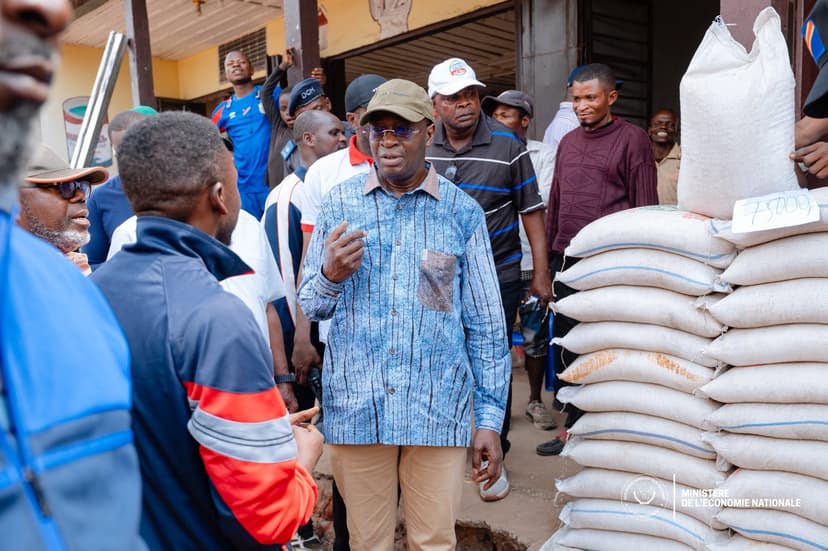
On an economic mission to the province of Sankuru, the Deputy Prime Minister and Minister of National Economy, Daniel Mukoko Samba, arrived in Lodja on Sunday 14 June 2026, as part of a mission devoted to ending the economic isolation of this part of the country.
The mission aims to identify the main obstacles hindering production, the movement of goods and access to markets, in order to prepare responses suited to the economic realities of the province.
Upon arrival, the Deputy Prime Minister held a working session with the territorial authorities to discuss local economic priorities before beginning a series of field visits intended to assess conditions in the territory and identify levers for action.
Accompanied by Lodja’s community leaders, Daniel Mukoko Samba visited the Roads Authority (Office des routes), where he held talks with the Provincial Director, Serge Mukamba Tunga. The visit enabled him to observe the condition of the agency’s equipment fleet, which includes seven dump trucks, excavators and compactor trucks that are currently not in use.
The mission continued at the Lokenye bridge, the main entry route for goods arriving in Lodja from Kinshasa via the port of Bena-Dibele, in the territory of Kole. With a capacity of 42 tonnes, this structure is a strategic route linking the territory of Lodja to the west and providing access to the province of Tshopo to the east.
The Deputy Prime Minister also visited the Okoto landing point on the Lokenye River. Navigable all the way to Kinshasa, this waterway supports economic trade through whaleboats with a carrying capacity of 80 to 100 tonnes, which contribute
to supplying the town with materials. However, the site remains underused owing to the lack of navigation markings along the waterway.
As part of this tour, Daniel Mukoko Samba also visited the erosion sites along National Road No. 7 (RN7), near the Lokenye bridge, as well as the solar mini power plant intended to supply electricity to the territory of Lodja.
On this occasion, the Deputy Prime Minister stressed that the main economic challenge facing Sankuru remains its isolation. "It is not normal that a bottle of Coca-Cola sold for 2,500 FC in Kinshasa should cost up to 8,000 FC in Lodja, or that a bag of cement should reach the equivalent of 50 US dollars. This is the fundamental problem that must be solved. The objective of this mission is to find concrete economic solutions to open up Sankuru, but also to advocate for the acceleration of works in the province," declared the head of the Economy Ministry.
Regarding the state of road infrastructure, he announced the forthcoming adoption of urgent measures to preserve the continuity of the RN7. "We must prevent the RN7 from being cut off, because any interruption would immediately lead to a sharp rise in prices in Lodja," he added.
Through this mission, the Government intends to better connect Sankuru to national economic circuits by improving conditions for the movement of people, goods and local production.
The Deputy Prime Minister concluded his day of 14 June with a meeting with representatives of civil society as well as with economic operators who are members of the Federation of Enterprises of Congo (FEC) in Lodja.
Consultations with local authorities, civil society and economic operators will continue throughout the mission in order to inform the economic diagnosis of the province and identify priority interventions likely to support development.
Done in Lodja on 14 June 2026 Communication Unit
Related articles

CLARIFICATION FROM THE MINISTRY OF NATIONAL ECONOMY Regarding the article entitled: “Combining wholesale and retail trade: what the Ministry of Economy prohibits, what the 1973 law permits”
CLARIFICATION FROM THE MINISTRY OF NATIONAL ECONOMY The Ministry of National Economy welcomes and thanks the press and all those who have shown interest in the …

PRESS RELEASE No. 158/2026 - Q2 2026: CSPPP certifies USD 146 million in PMAG for all supply zones
PRESS RELEASE No. 158/2026 Q2 2026: CSPPP certifies USD 146 million in PMAG for all supply zones On Thursday 13 and Friday 14 August 2026, the Petroleum Product…

PRESS RELEASE No. 159/2026 - Lusambo: Economic operators receive their formalisation documents
PRESS RELEASE No. 159/2026 Lusambo: Economic operators receive their formalisation documents Following the visit of the Deputy Prime Minister, Minister of Natio…

PRESS RELEASE No. 154/2026 - The Deputy Prime Minister, Minister of National Economy, receives a delegation from the Scientific Elite Corps of UDPS/Tshisekedi
PRESS RELEASE No. 154/2026 The Deputy Prime Minister, Minister of National Economy, receives a delegation from the Scientific Elite Corps of UDPS/Tshisekedi The…

PRESS RELEASE No. 152/2026 - DPM Daniel Mukoko Samba calls for increased investment in health at the opening of the 2nd edition of the Hospital Fair
PRESS RELEASE No. 152/2026 DPM Daniel Mukoko Samba calls for increased investment in health at the opening of the 2nd edition of the Hospital Fair On Thursday, …

PRESS RELEASE No. 151/2026 - Accelerating access to safe drinking water and electricity: Deputy Prime Minister Daniel Mukoko Samba held an introductory meeting with stakeholders
PRESS RELEASE No. 151/2026 Accelerating access to safe drinking water and electricity: Deputy Prime Minister Daniel Mukoko Samba held an introductory meeting wi…