

Mukoko Samba inspects the supply chain for local production
PRESS RELEASE No. 93/2025
Mukoko Samba inspects the supply chain for
local production
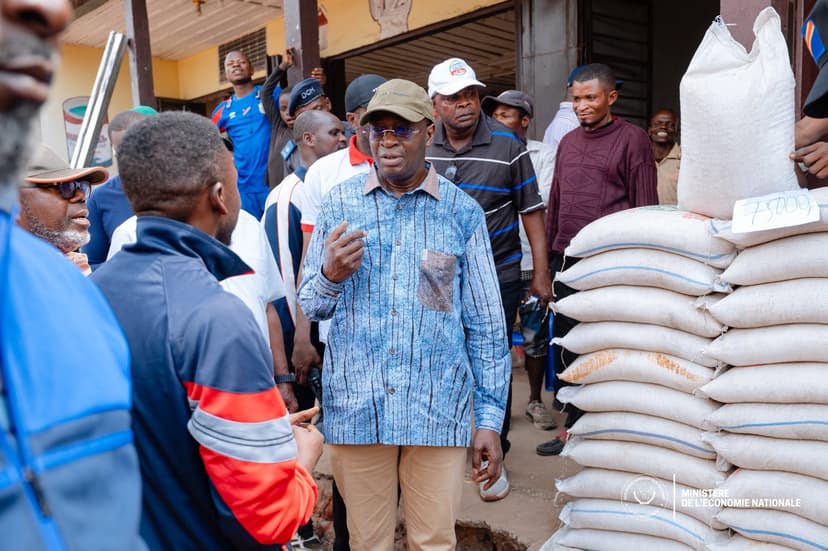
As part of the annual monitoring of domestic market supply at the end of the year, the Deputy Prime Minister, Minister of National Economy, Daniel Mukoko Samba, conducted on Tuesday, 30 December 2025, a series of visits to several ports in the city of Kinshasa. Among other sites, he visited the Kinkole public fishing port as well as several ports in the commune of Gombe, including Baramoto and the CDI Bwamanda port. The main objective of these field visits was to ensure the proper functioning of the supply chain for local production, from production areas to distribution on the urban market. At the Kinkole public fishing port, the Deputy Prime Minister observed the presence of sacks of grain from the provinces of Kwilu, Maï-Ndombe and Kasaï. He also visited the section for dried cassava chips unloaded from whaleboats. This port receives on average three to four vessels per week, some dedicated to unloading agricultural products, others to loading manufactured goods bound for the interior of the country. The ministerial delegation then went to the port of Baramoto, located in the commune of Gombe, to assess the difficulties affecting the supply chain. This port, part of a cluster of several ports divided into six zones, accommodates metal vessels with a capacity of up to 3,000 sacks of produce. The final stage of the visit took the Deputy Prime Minister to the CDI Bwamanda port, also in the commune of Gombe. On site, Daniel Mukoko Samba toured the production plant, whose capacity is 50 tonnes per day for the old unit and 50 tonnes per day for the new one, for a total capacity of 100 tonnes per day. This is equivalent to more than 10,000 sacks of 10 kg per day or approximately 2,500 sacks of 25 kg intended for the Kinshasa market.
Speaking on this occasion, Sangina Toko Édouard, assistant to the Director General of CDI Bwamanda, welcomed the Deputy Prime Minister’s visit, which he described as very encouraging at a time when CDI Bwamanda is facing numerous difficulties. He recalled that CDI Bwamanda long contributed to feeding the city of Kinshasa, notably during the 1980s, 1990s, 2000s and 2010s. However, as a non-profit organisation (ASBL), the institution has suffered from declining subsidies, which explains its current difficulties. According to him, the main challenges concern access to quality seeds, weak support for farmers, and the condition of road infrastructure, which hampers the transport of produce even when production is sufficient. He stressed that CDI Bwamanda nevertheless has significant capacity to revive its activities, provided it receives substantial financial support from the State, in particular to strengthen rural development services and to set up storage silos. To date, CDI Bwamanda has adequate infrastructure, with more than seven depots of 2,000 m² each in Kinshasa, large warehouses in the interior of the country, as well as facilities dedicated to the storage and processing of maize. It thus positions itself as a reliable partner that the State can support in order to contribute sustainably to the national food supply. For his part, the Deputy Prime Minister, Minister of National Economy, stressed the need to build a complete and structured value chain, from production to distribution. He noted serious shortcomings in the current organisation of the sector, particularly with regard to the quality of local maize, which struggles to compete with imported products that are better structured in terms of logistics and standards. Daniel Mukoko Samba therefore called for the standardisation and supervision of the entire value chain for local production, from production areas to consumer markets.
Done in Kinshasa, 30 December 2025
Communication Unit
Mukoko Samba inspects the supply chain for local production
Related articles

CLARIFICATION FROM THE MINISTRY OF NATIONAL ECONOMY Regarding the article entitled: “Combining wholesale and retail trade: what the Ministry of Economy prohibits, what the 1973 law permits”
CLARIFICATION FROM THE MINISTRY OF NATIONAL ECONOMY The Ministry of National Economy welcomes and thanks the press and all those who have shown interest in the …

PRESS RELEASE No. 158/2026 - Q2 2026: CSPPP certifies USD 146 million in PMAG for all supply zones
PRESS RELEASE No. 158/2026 Q2 2026: CSPPP certifies USD 146 million in PMAG for all supply zones On Thursday 13 and Friday 14 August 2026, the Petroleum Product…

PRESS RELEASE No. 159/2026 - Lusambo: Economic operators receive their formalisation documents
PRESS RELEASE No. 159/2026 Lusambo: Economic operators receive their formalisation documents Following the visit of the Deputy Prime Minister, Minister of Natio…

PRESS RELEASE No. 154/2026 - The Deputy Prime Minister, Minister of National Economy, receives a delegation from the Scientific Elite Corps of UDPS/Tshisekedi
PRESS RELEASE No. 154/2026 The Deputy Prime Minister, Minister of National Economy, receives a delegation from the Scientific Elite Corps of UDPS/Tshisekedi The…

PRESS RELEASE No. 152/2026 - DPM Daniel Mukoko Samba calls for increased investment in health at the opening of the 2nd edition of the Hospital Fair
PRESS RELEASE No. 152/2026 DPM Daniel Mukoko Samba calls for increased investment in health at the opening of the 2nd edition of the Hospital Fair On Thursday, …

PRESS RELEASE No. 151/2026 - Accelerating access to safe drinking water and electricity: Deputy Prime Minister Daniel Mukoko Samba held an introductory meeting with stakeholders
PRESS RELEASE No. 151/2026 Accelerating access to safe drinking water and electricity: Deputy Prime Minister Daniel Mukoko Samba held an introductory meeting wi…